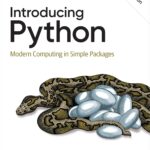
Many developers find themselves in a peculiar state of limbo after learning the basic syntax of a new language. You know the loops, the conditionals, and the data types, but you’re staring at a blank editor, uncertain how to assemble those pieces into a functioning, useful application. That is the difference between knowing the words and knowing how to write a coherent essay. Bill Lubanovic’s Introducing Python is squarely aimed at bridging that exact gap.
This book isn’t a quick-and-dirty tour. It’s a structured expedition. Think of it less as a dictionary and more as a detailed architectural blueprint for building your skills. It takes the fundamental building blocks of Python and shows you how to construct something meaningful with them, a critical step that many introductory resources gloss over.
Who Should Read This, and Why?
The book’s value shifts depending on where you’re in your development journey. Let’s break down its utility for different kinds of practitioners.
For the Curious Newcomer
If you’re entirely new to programming, you face a significant risk: learning bad habits. This book offers a solid footing. Instead of just showing you what a function is, it guides you toward understanding why you should structure your code that way. You’ll get a comprehensive overview that scales correctly—from simple variables all the way to interacting with databases and APIs. This provides the context that turns syntax into a real skillset.
- Practical Advice: Don’t just read it. Type out every example. Tinker with them. Break them and fix them. The goal isn’t just to consume the information but to build the muscle memory and problem-solving instincts of a developer.
For the Advanced Beginner
That is perhaps the book’s sweet spot. You’ve completed a few tutorials, you understand the basics, but you feel stuck. You don’t know how to organize a larger project, manage dependencies, or even where to start with testing. Lubanovic effectively takes you by the hand and walks you through these next logical steps.
- Practical Advice: Focus on the chapters covering code reuse, debugging, and the standard library. These sections are your roadmap out of the “tutorial labyrinth.” Pick a small personal project—like a script to organize your files or scrape a favorite website—and use this book as your guide to build it robustly. The new chapters on performance will be particularly valuable as your small projects start to grow.
For the Intermediate Developer (from another language)
If you’re coming to Python from Java, C#, or another language, your challenge isn’t learning programming logic but learning the “Pythonic” way of doing things. You can write C-style `for` loops in Python, but you shouldn’t. The book will help you recalibrate your thinking.
- Practical Advice: You can likely skim the early chapters. Your gold is in the sections on data structures, comprehensions, and generators. Pay close attention to how this book handles tasks like file I/O and data manipulation. It will teach you how to write code this is not only functional but also elegant, idiomatic, and efficient in the Python ecosystem. The sections on data science and the new AI model integrations will show you where Python truly shines in the modern landscape.
The core strength of Introducing Python is its practicality and breadth. It doesn’t treat topics in isolation. It demonstrates how to use Python for a variety of real-world domains:
- Files, networks, and databases
- Web development and APIs
- Data science and analysis
- Testing and debugging
This contextual approach helps you see the language not as an academic exercise, but as a powerful, versatile tool for getting things done. It’s an investment in moving from someone who can write Python code to someone who can confidently build and maintain Python applications.