Skip to content
Python FAQ

Practical answers to common Python questions, with useful code examples and explanations.

  • Home
  • Home
Books
Home » Python modules » Django
How to set up user authentication and permissions in Django in Python
Posted inDjango

How to set up user authentication and permissions in Django in Python

Posted inDjangoTags: Django auth, permissions, user roles
Custom user permissions and roles in Django enhance access control within applications. By defining permissions in a model's Meta class and utilizing Django's user and group frameworks, developers can assign specific permissions and manage user access effectively. Implement permission checks using decorators and mixins for robust security.
Read More
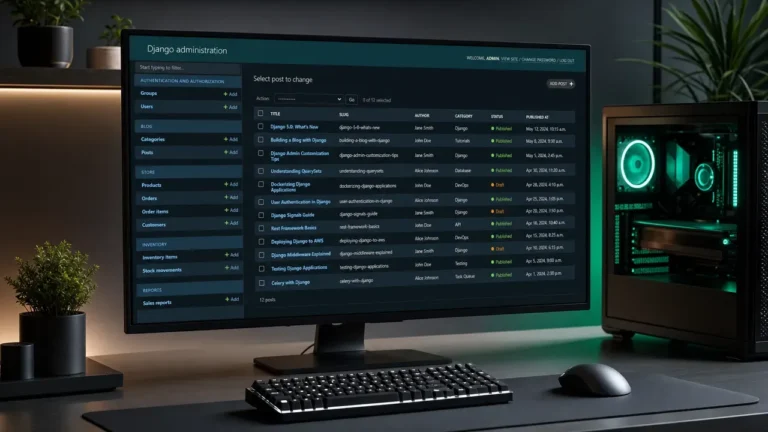
How to use Django admin for backend management in Python
Posted inDjango

How to use Django admin for backend management in Python

Posted inDjangoTags: backend tools, Django admin interface
Django admin optimization techniques include using inline models for managing related objects, customizing list displays with sortable and editable columns, creating custom filters with SimpleListFilter, implementing bulk editing actions, and improving performance with list_select_related and list_prefetch_related for efficient database queries.
Read More
How to manage static and media files in Django in Python
Posted inDjango

How to manage static and media files in Django in Python

Posted inDjangoTags: Django static files, media management
Media files in Django include user-uploaded content like images and documents. Proper setup involves configuring MEDIA_URL and MEDIA_ROOT, secure file validation with FileField and ImageField, using dedicated servers or CDNs for production, organizing storage, asynchronous processing, and automated cleanup of unused files.
Read More
How to implement user input forms in Django in Python
Posted inDjango

How to implement user input forms in Django in Python

Posted inDjangoTags: Django forms, form handling
Create a Django feedback form with fields for name, email, and message in forms.py. Implement view logic to handle GET and POST requests, validate user input, and display errors. Use Bootstrap for styling in the feedback template. Route URL patterns in urls.py for form processing and redirection to a thank-you page.
Read More
How to generate dynamic HTML with Django templates in Python
Posted inDjango

How to generate dynamic HTML with Django templates in Python

Posted inDjangoTags: Django templates, HTML rendering
Template tags in Django enhance templates by enabling logic execution, such as conditionals and loops. Common tags include {% if %} for conditional rendering and {% for %} for iterating over data. Django's built-in filters modify output, and custom filters extend functionality, promoting cleaner, more maintainable code in applications.
Read More
How to handle URL routing in Django in Python
Posted inDjango

How to handle URL routing in Django in Python

Posted inDjangoTags: Django URL routing, path mapping
Advanced routing techniques in Django enhance URL management without sacrificing clarity. Utilize built-in tools for dynamic URL generation and custom URL converters for complex validations. Implement meaningful keywords for SEO, versioning for APIs, and maintain organized URL patterns to ensure scalability and usability in your application.
Read More
How to use function-based and class-based views in Django in Python
Posted inDjango

How to use function-based and class-based views in Django in Python

Posted inDjangoTags: CBV, Django views, FBV
Function-based views (FBVs) in Django offer simplicity for small applications, while class-based views (CBVs) provide organization and reuse through inheritance and mixins. Django's generic views simplify common tasks like detail and list views, improving code maintainability and reducing duplication.
Read More
How to build models for database interaction in Django in Python
Posted inDjango

How to build models for database interaction in Django in Python

Posted inDjangoTags: database integration, Django models
The bridge between Python objects and a database relies on translating a class into a CREATE TABLE statement. Robust ORMs use descriptor objects and metaclasses for schema definition. A migration system then handles schema evolution by comparing models to the database and generating SQL changes.
Read More
How to get started with Django in Python
Posted inDjango

How to get started with Django in Python

Posted inDjangoTags: Django setup, installation guide
Django's ORM for database management with Python classes as models. Define a schema in models.py using CharField, TextField, and ForeignKey. Use makemigrations and migrate to update the database. Create and save records by manipulating Python objects, avoiding raw SQL queries.
Read More
Copyright 2026 — Python FAQ. All rights reserved.
Scroll to Top