How to schedule delays with asyncio.sleep in Python

How to schedule delays with asyncio.sleep in Python

Implementing delays in asyncio applications is efficiently managed with the asyncio.sleep() function. Unlike time.sleep(), asyncio.sleep() is non-blocking, allowing concurrent execution of coroutines. This function supports complex timing behaviors, timeout management, and enhances application responsiveness. Key features include asyncio.gather() for concurrent tasks and asyncio.wait_for() for timeout handling.

How to select and evaluate models with scikit-learn in Python

How to select and evaluate models with scikit-learn in Python

Scikit-learn model selection requires a structured approach, emphasizing best practices such as pipelines for preprocessing and model fitting. Effective strategies include k-fold cross-validation for performance estimation, hyperparameter tuning with RandomizedSearchCV, and documenting experiments for insights. Balancing model complexity with interpretability is crucial.
Python

How to handle complex objects with a JSONEncoder subclass in Python

Custom JSON encoders facilitate serialization of non-standard data types like datetime and Decimal. The DateTimeJSONEncoder converts datetime objects to ISO 8601 strings, while the MixedTypeJSONEncoder handles both Decimal and datetime, ensuring compatibility. Performance monitoring is essential for optimizing serialization, especially with large datasets.
How to render text and use fonts in Pygame in Python

How to render text and use fonts in Pygame in Python

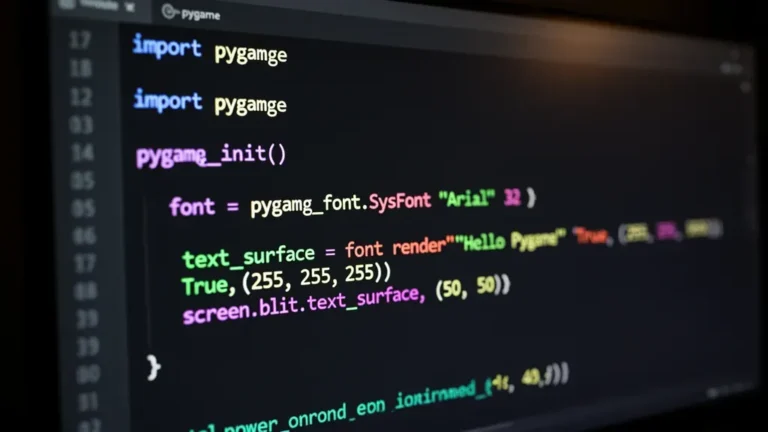
Optimize font usage in Pygame by implementing a font manager for preloading and caching fonts, minimizing runtime loading overhead. Improve performance by updating text surfaces only when necessary, using sprite groups for multiple text elements, and profiling your application to monitor rendering times. Manage font resolution and variety to ensure smooth gameplay.